mer 18 juil 2007
Yves Saint Laurent
On July 14 (Bastille day), 2007, Yves Saint Laurent opened France's Légion d'honneur nominations ball. He received the rank of "grand officier de la Légion d'honneur," a pretty present (his 71st birthday will be celebrated on August 1st) for the man who until 2002 lead of one of the most prestigious haute couture houses.

Yves Saint Laurent was the kind of man who carved out his destiny with his talent and passion. At 9 years, while blowing out his birthday candles, he declared that one day his name would be in lights on the Champs Elysées. As a teen, he wrote imaginary orders for clothes for his sisters.
At 18, he moved to Paris where he enrolled in drawing classes at the Chambre Syndicale de la Couture. He was there only three months when Christian Dior noticed him and offered him a job as a dress designer. In 1955, Saint Laurent joined Dior where for two years he perfected his cutting techniques and learned the ways of the high fashion world at his mentor's side.
In 1957, after Dior's sudden death, the 21 year old Saint Laurent found himself pushed into the director's position of Christian Dior. This was a turning point in the history of fashion, between the post war period and the beginning of mass production. However, in 1961, he left Dior and with the help of Pierre Bergé created the house of Yves Saint Laurent, with Bergé as financial manager.
Between these two men existed a perfect alchemy that bound them together like the great duos together in history. Saint Laurent presented his first collection on January 29, 1962. Incredible rumors circulated preceding the launch of the collection, e.g. the pieces were not yet finished, and that the designer was incapable of seeing his creations through to the end.

The event was highly anticipated. Seated in the first row were Baroness of Rothschild, Françoise Sagan (French author), the Countess of Paris and all the influential people in fashion. Saint Laurent knew the stakes were high and that his future depended on the reaction to his "Trapeze" collection. The audience was completely won over by the unique style of this young designer.
The trapezoidal silhouette enchanted the women, and announced the beginning of the prêt-a-porter era that, combined with the social changes of the 1960s, would become the biggest revolution in clothing. Saint Laurent succeeded in introducing into his creations a certain abstraction while respecting the rules of haute couture. He also managed to elevate sportswear into the center of fashion.

From that moment, he became the uncontested master of French haute couture. He is credited with most, if not all that is ultra modern in fashion due to his vision that he imposed on the world at the moment that the world was changing. Thigh high boots in crocodile, transparent tunics, and daring color combinations... Saint Laurent was an incredible visionary, and all of his innovations have since become basics.
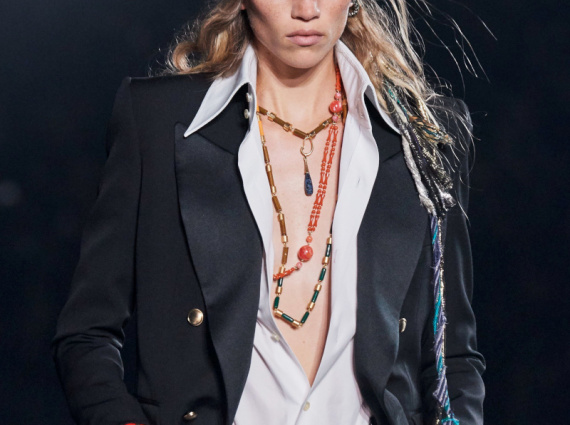
In 1966, he designed his first smoking jacket for women, which became his label's trademark. Each year, he presented a new version of his smoking jacket. In 1966, the duo Bergé/ Saint Laurent launched Yves Saint Laurent Rive Gauche, a line whose pieces were designed by the master but mass produced by a third party factory.
Saint Laurent is a man who constantly takes inspiration from the world surrounding him. In May 1968, France's social revolution was under way; the designer was in osmosis with the streets and created a new look where pants, previously considered unsuitable for women, played the leading role. He reinterpreted the hunting outfit and made it into an urban classic, and the laced Sahara earned its right to stroll down the streets of Paris.
The famous model Verushka wonderfully illustrated this new image of women, rebellious and conquering. Models were very important for the designer. In 1973, when his collection received a lukewarm reaction, Saint Laurent declared that it was because he did not have "good models."

Women were essential to Saint Laurent's creation process. Once the sketch was finished, the designer needed to form his clothes on models and according to his feeling, develop the cuts and details. No one was surprised when in 1972, Loulou de la falaise, Saint Laurent's muse, became a part of his studio.
Saint Laurent needed Loulou on a daily basis. She inspired him and allowed him to glimpse what women wanted. He was above all a pioneer: he had started prêt-a-porter in the 1960s, went beyond the minimalist urban style that held sway on the fashion scene in 1967, and continued on to a return-to-nature that would become one of the big musts of the 1970s.

Men's collections, a Matisse homage collection, the huge Kouros men's perfume launch, and an evening in the company of Paloma Picasso -- Saint Laurent was everywhere and loved by everyone. In 1982, he celebrated 20 years of the house of Yves Saint Laurent, received the International Fashion Award of the Council Fashion Designers of America, and was at the summit of his glory.
In 1985, he received an Oscar du plus grand Couturier. In 1988, his haute couture show was an ode to Van Gogh, whose aesthetic he interpreted on embroidered vests some of which required 600 hours of work. In 1989, the Yves Saint Laurent group went public.
In 1990, Saint Laurent created a collection called "Hommages" to all the artists that inspired him over the years, from Bernard Buffet to Marcel Proust and Catherine Deneuve. The show received a 10-minute standing ovation and the critics called it the designer's strongest collection, simultaneously "pure in its conception and fantastic and lyrical in its colors..."
But the fashion world was more and more coveted by the big conglomerates. In 1998, YSL was bought by François Pinault, which was followed by new marketing and financial directions. The Texan Tom Ford was placed at the head of YSL Rive Gauche.

Ford's concept of elegance destabilized Saint Laurent; times had changed and the grand monsieur of fashion decided in 2002 to take his final bow and dedicate himself to the foundation he had started with Bergé. Patronage and managing the museum dedicated to his career now made up his daily routine.
Now it is our turn to render homage to the man who once said, "Nothing is more beautiful than the naked body. The most beautiful piece of clothing a woman can wear is the arms of the man she loves. However, for those who have not yet had the chance to find that happiness, I am here."
By Coco in Designers - Post a comment - 1