jeu 8 nov 2007
Balenciaga
Since Nicolas Ghesquière took over Balenciaga, the house has renewed its connection to Cristobal Balenciaga, the self-taught stylist considered by his peers to be the designer of designers, and its flamboyant past. Inspired, visionary, and revolutionary, the Balenciaga style irreparably marked and transformed the world of fashion.

For the keffieh neophytes or blazer buffs, Balenciaga is Nicolas Ghesquière is "it" pieces and all that is hip. Nevertheless, it is good not to forget why Ghesquière is so attached to this house, why the brand's past is an important page in the history of fashion and also, who was Mr. Balenciaga.
Cristobal Balenciaga was born in 1895 in the Basque region of Spain. As a young man, he worked as a buyer. At that time, in 1910, the three major players in fashion were three women: Elsa Schiaparelli, Madeleine Vionnet and Gabrielle Chanel. Balenciaga was fascinated by their creations, to the point that he would buy their pieces, take them apart, then put them back together until he understood the sewing mechanisms used to make them and the secret of their cuts. He finished by modifying them and extracting from them his own clothes.
His style was influenced by his desire to study the construction of clothing, to maximize the power of the cut. In 1919, he opened his first boutique in San Sebastian and developed his love for model making, working his creations like an architect would a construction site. He opened other points of sale in Spain, but it was when he expatriated himself to Paris to escape the war in 1937 that success smiled upon him.

Balenciaga unpacked his suitcases at 10 avenue George V and created his first collection. The clients that attended his show were enthusiastic and the press quickly spread the news of their excitement. During WWII, he was one of the rare designers that did not close shop. Instead, he took advantage of the poor supply of fabric to elaborate his cutting techniques that allowed him to obtain volumes without accumulating layers of material.
In 1946, his Tonneau line and his famous boleros appeared. Balenciaga was one of the only designers of his time who really knew how to sew (others only sketched their creations). His knowledge of sewing and cutting techniques allowed him to invent new volumes and to make his creations hang in an incredible way.
He launched his first perfume named "10" after his address. In 1948, he opened the Balenciaga boutique in the same building as his ateliers, at 10 avenue George V. At that time, it was à la mode to launch perfumes (with Coco Chanel's being a remarkable international success), and Balenciaga developed La fuite des heures; in 1962, he created l'Eau de Balenciaga.

The 1950s saw an uncontestable turn towards the past, with numerous allusions to the elegant dressing of the early 1900s. Societal changes, however, would give rise to innovations by the designers; in particular, Balenciaga liberated women from their girdles by creating the unfitted suit. Quickly thereafter, he developed a new silhouette: he dropped the waistline and drew minimalist volumes, and the mastery of the cut created perfect pieces conferring ease and elegance to those who wore them.
It was in this context that he invented the marinière (the classic French striped t-shirt), which would quickly become a basic, as would many of his creations. He revolutionized fashion, stripped his pieces down more and more, and sought to obtain an ultimate volume, the perfect seam. He worked on the shirtdress and the tunic, and his digressions on these themes enchanting his clientele, even though his style was counter-current to the prevailing "new-look."
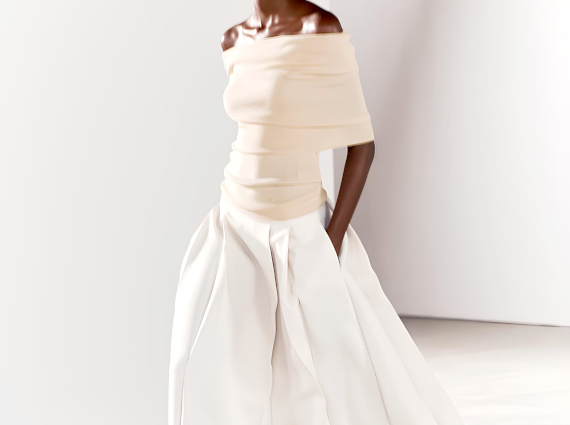
The baby doll, which was in 1958 the masterpiece of his collection, is credited to Balenciaga. During the same period, he discovered a new fabric, Abraham's Gazar that would strongly influence his work. This rigid fabric made it possible to create new volumes and to obtain shapes impossible in more supple fabrics. He continued to refine his style, as his 1967 wedding dress perfectly illustrates.

During the 1960s, he created one micro-revolution after another. His sports suits were paired with boots, creating a virtual stylistic sensation at the time. He visualized his silhouettes in three dimensions, which then became abstract or even conceptual. One of the major characteristics of the Balenciaga style is this abstraction of shapes made from unfitted tailoring and trapezoidal volumes.
Despite the success, fame, respect and admiration he enjoyed, Balenciaga decided to close his house in 1968. His last contribution to fashion was the Air France flight attendant uniforms. He refused to adapt himself to the new way of working, i.e. the prêt-a-porter that he considered "a wave of vulgarity crashing against fashion," and left the universe that was so precious to him.
He retired to Spain and died in 1972, and the house that carried his name found it difficult to find a new soul on the same level as that of the former creator. It was purchased by several groups and finished as part of the Pinault Printemps Redoute group in 2000.

However, since 1995, things have been changing for the moribund house: a young self-taught designer, broken in at Agnès B and Jean Paul Gaultier, began giving, little by little, life back to the work of Balenciaga. This young designer is Nicolas Ghesquière, and in 1997, he became the house's artistic director. Taking his inspiration from the spirit of Cristobal Balenciaga and adding to it a modern touch, he brought to life the new generation Balenciaga, between kindred spirit and visionary genius.
According to some, he is the spiritual son of the original master of the house. His slightly futuristic approach to women's' prêt-a-porter won over the press and the critics, and in 2001 he was awarded the CFDA (Council of Fashion Designers of America) award for best designer of the year. The same year, Balenciaga was purchased by Gucci and became became ultra hip. The crowds of unconditional Ghesquière fans include Charlotte Gainsbourg (French actress), Asia Argento and Kate Moss. Every season's show is an event generating "it" items and trends.
The house seems to be intrinsically linked to Ghesquière as it was to Cristobal Balenciaga, and it would be hard to imagine disassociating it from its stylist without suffering again. We hope that the turnover sometimes seen in the big fashion houses will pass over the house of Balenciaga, leaving Nicolas Ghesquière where he is.
By Coco in Labels - Post a comment - 1